Greetings and Happy Easter {{first name | Producer}},
Welcome to the Weekly Herald for the week of 05 April 2026.
Each week, we return to the chronicles of the Middle Ages, marking anniversaries, revisiting battles, and tracing the enduring consequences of medieval history.
This week’s journey through the Middle Ages starts with a look at the medieval Easter Octave, then moves from thunderous cannon fire outside the walls of Constantinople to ice‑slick battlefields, papal letters, royal deaths, and far‑flung encounters at the heart of the Mongol Empire.
Easter in the Middle Ages

Scenes of Easter (1320), Nerius
In the Middle Ages, Easter stood at the very heart of the Christian year, shaped by weeks of austerity and culminating in an outpouring of ritual and celebration.
The season was preceded by Lent, a forty‑day period of fasting, penance, and prayer in which medieval Christians abstained from meat, dairy, and eggs, preparing spiritually for the resurrection.
Holy Week unfolded with elaborate ceremonies, Palm Sunday processions, the stripping of altars on Maundy Thursday, and the solemn mourning of Good Friday, before giving way to the drama and symbolism of the Easter Vigil, when new fire was lit, candles blazed in darkened churches, and the resurrection was proclaimed with bells and song.
When Easter Sunday arrived, restraint turned to rejoicing. The lifting of the Lenten fast meant feasting on foods long forbidden, especially eggs and lamb, both powerful symbols of new life and Christ’s resurrection.
Decorated eggs were exchanged as gifts, churches rang with music after weeks of silence, and communities celebrated throughout the Easter Octave, a full week of festivities.
In towns and villages, religious devotion blended with social life through processions, pageants, and communal meals, making Easter a moment when theology, ritual, and everyday medieval life came vividly together.
Christus surréxit! - Surréxit vere, allelúja (“Christ is risen!” - “He is risen indeed, Alleluia!”)

Siege of Constantinople (1453) by Jean Le Tavernier
April 6, 1453 - The Siege of Constantinople Begins
In April 1453, the young Ottoman sultan Mehmed II began his assault on the greatest city of the medieval world, the fortified capital of the Byzantine Empire: Constantinople. For more than a thousand years the city’s walls had defied attackers, but the balance of power was shifting.
For centuries, the Byzantine Empire had endured as the last remnant of Rome, its capital protected by the legendary Theodosian Walls, which had turned back wave after wave of invaders.
Ottoman forces arrived with overwhelming manpower, carefully planned logistics, and most ominously massive cannons designed to batter the city’s legendary defenses.
Inside Constantinople, Emperor Constantine XI commanded a vastly outnumbered garrison made up of Byzantines, Genoese allies, and volunteers, for what would become a final, desperate defense.
What followed over the next seven weeks was a grinding contest between medieval fortification and early gunpowder warfare.
When the city finally fell on 29 May 1453, it marked more than the end of a siege: it signaled the collapse of the Byzantine (Roman) Empire, the rise of Constantinople as Istanbul, and a profound shift in the political, cultural, and economic map of the Mediterranean world.
THIS WEEK IN THE MIDDLE AGES
05 April 1254 - William of Rubruck Meets Möngke Khan
The Flemish Franciscan William of Rubruck reaches the Mongol court and meets Möngke Khan, ruler of a vast empire stretching across Eurasia. His journey offers one of the most detailed Western accounts of the Mongol world, bridging cultures in an era often defined by conquest.
06 April 1320 - The Declaration of Arbroath
Scottish nobles issue the Declaration of Arbroath, asserting Scotland’s independence and the legitimacy of Robert the Bruce as king. The document is remarkable for its language on sovereignty and collective political identity, making it one of the most famous statements of medieval statecraft.
07 April 529 - Justinian Issues the First Draft of the Corpus Juris Civilis
In Constantinople, Emperor Justinian I issues the first draft of the Corpus Juris Civilis, an ambitious effort to codify Roman law. Its influence would shape European law for centuries and still influences legal systems today.
06 April 1199 - The Death of Richard the Lionheart
King Richard I of England dies from an infection after being wounded by a crossbow bolt during a minor siege in France. Renowned as a crusader king and warrior, Richard’s death leaves a complicated political legacy behind him.
THE ILLUMINATION

Bayeux Tapestry, Scene 27 & 28 (Public Domain)
27 - HIC EADWARDUS REX IN LECTO ALLOQUIT[UR] FIDELES
28 - ET HIC DEFUNCTUS EST
(27 - Here King Edward in bed speaks to his faithful followers, 28 - and here he died)
THE HERALD'S LEXICON
Word of the Week: FIEF
Land or an office granted by a lord in return for service.
FROM THE FORGE
Last week the Medieval Papacy examined the life of one of the greatest popes in history. This week we look at one of the worst, Pope John XII, referred to as the “Playboy Pope”

On the battlefront, we look at a peasant victory that shocked a nation.

The Battle on the Ice took place on 05 April 1242. Read about the battle in our Medieval Battles series.

Or listen to our podcast episode.

PODCAST OF THE WEEK
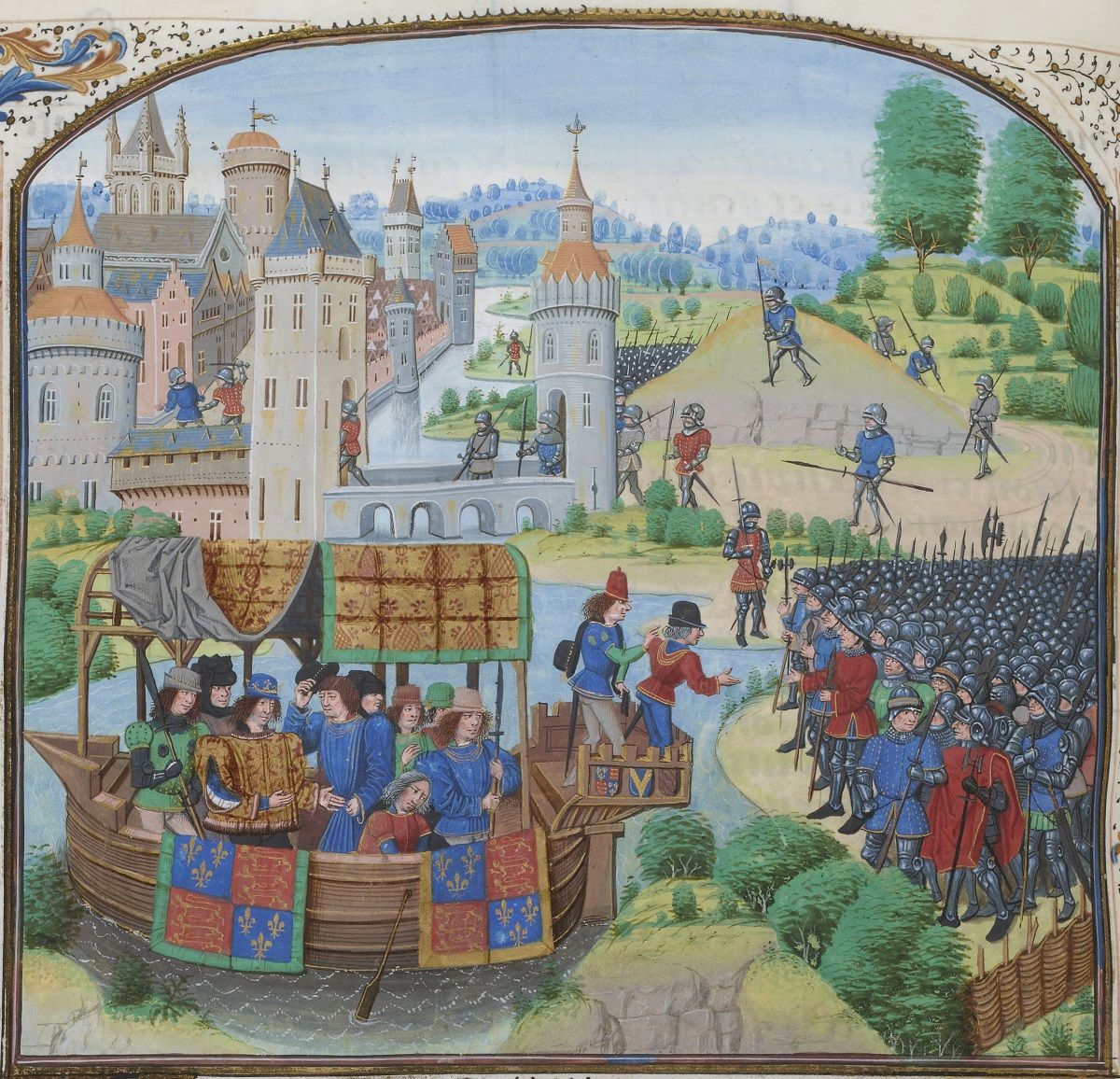
Explore another Peasant Uprising
Settle the Record
Question of the Week:
The Viking Age is officially considered to have begun with a brutal, shock raid in 793 AD on an abbey located on what English "Holy Island"?
- Answer
“Let all guests who arrive be received like Christ.”
Passing the Weekly Herald along to a fellow history enthusiast is one of the simplest ways to support Medieval Archives.
